
Sonali Sharma
I am a Geospatial Analyst and Urban ecologist actively seeking opportunities to deliver nature-positive and climate resilient solutions at the intersection of Earth observation, GeoAI and Environmental planning. With 8+ years of experience, I specialize in transforming complex 2D & 3D spatial data into planning-relevant insights that cities, regions and nature need. I have built geospatial workflows connecting LiDAR, high resolution land cover and socio-economic data for urban and nature environments.
I hold a PhD in Environmental Sciences and bring international work experiences across India, Germany, and Finland. My work is driven by the aim of using spatial analysis as a bridge between data, eco-environmental systems, and decision-making. With spatial skillsets, interdisciplinary background and cross-cultural adaptability, I am particularly interested to be part of organisations where geospatial intelligence can support climate adaptation, biodiversity-sensitive and nature-based solutions planning.
Interests
- Earth Observation & Satellite Data Science
- GeoAI & Spatial Deep Learning
- Remote Sensing & GIS Analytics
- LiDAR for Built & Green (3-D) Structure Analysis
- Urban & Environmental Planning
- Green Infrastructure & Nature-based Solutions
- Biodiversity; Landscape & Urban Ecology
- Ecosystem Services Modelling
- Carbon Accounting & Climate Reporting
- Reproducible Geospatial Workflows
- Science–Policy Interface
Work Experiences
R&D Engineer
Develop and test LiDAR-processing workflows using Terrasolid software for airborne, mobile and terrestrial point-cloud applications. Design automated TerraScan macros for point-cloud classification, quality control and the identification of artefacts such as low points, multipath errors and glass-roof reflections. Develop workflows for urban tree inventories, above-ground biomass and carbon estimation, translating research methods into practical and reproducible geospatial solutions.
Terrasolid SoftwareLiDAR ProcessingTerraScan MacrosPoint-Cloud ClassificationUrban Tree InventoryBiomass and CarbonR&D to Application
Postdoctoral Researcher
Automated GIS workflows integrating LiDAR and high-resolution land cover data, cutting processing time by 70%. Built reproducible ML pipelines for 3D urban and green structure analysis. Analysed bird biodiversity data to link species occurrence with urban structural heterogeneity, producing planning-relevant spatial insights. Coordinated interdisciplinary work with the Finnish Environment Institute, delivering scientific outputs and map products. Presented findings at stakeholder engagement workshops and international conferences.
PythonRLiDARHPCQ/ArcGISMachine learning 3D Urban typologyHybrid associationsStakeholder engagementScientific reportingUrban biodiversity planning
Visiting Doctoral Researcher DAAD Fellow
DAAD Bi-national Fellowship recipient. Led research on future plausible urban growth and climate change scenarios and their implications on ecosystem services. Worked with German research teams and presented at international conferences focused on sustainability and geospatial methods.
ArcGISPythonRGoogle Earth EngineIPCC climate scenariosUrban growth modelling
Doctoral Researcher (PhD)
Modelled urban ecosystem services — soil erosion, flood regulation, heat regulation, and carbon sequestration — across two Himalayan landscapes. Integrated multi-source datasets (climate, land cover, remote sensing) to analyse urban growth dynamics and heat island effects. Mentored junior researchers in GIS workflows and spatial data processing.
ArcGISPythonRGoogle Earth EngineEcosystem ServicesWatershed modellingSpatio-temporal assessmentSocio-economic dataHeat island mapping
Projects
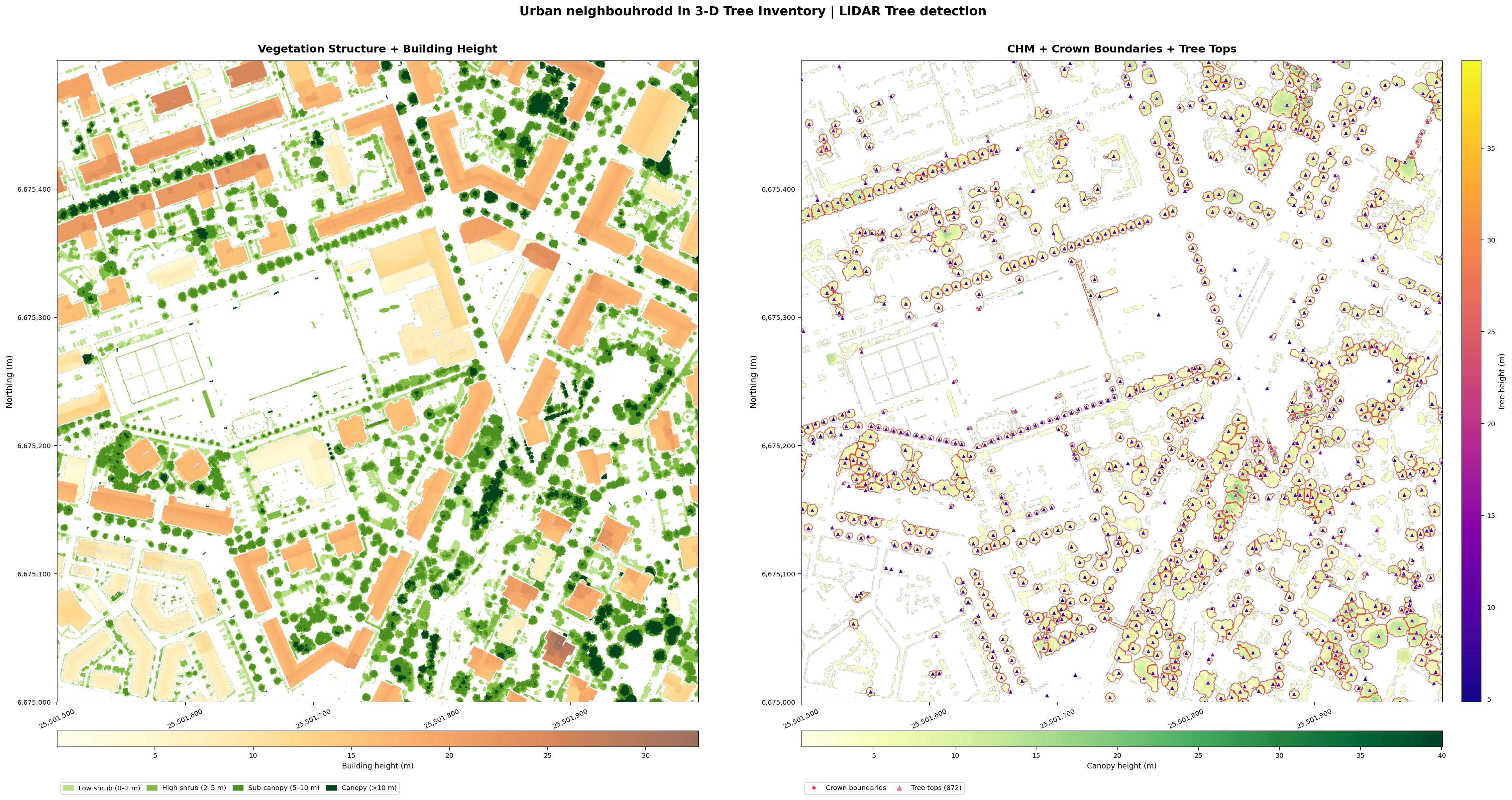
Automated Urban Structure Inventory from LiDAR
Urban green planners spend hundreds of Euros on manual tree surveys. This pipeline turns a single open-access LiDAR file into a complete urban structure inventory — with shrubs as height-classified vegetation patches & 872 individual trees — with locations, heights, and crown extents; alongside wall-to-wall building heights — in one reproducible notebook run.
Ready to feed directly into green infrastructure audits, urban heat mitigation plans, shadow modelling or carbon accounting workflows.
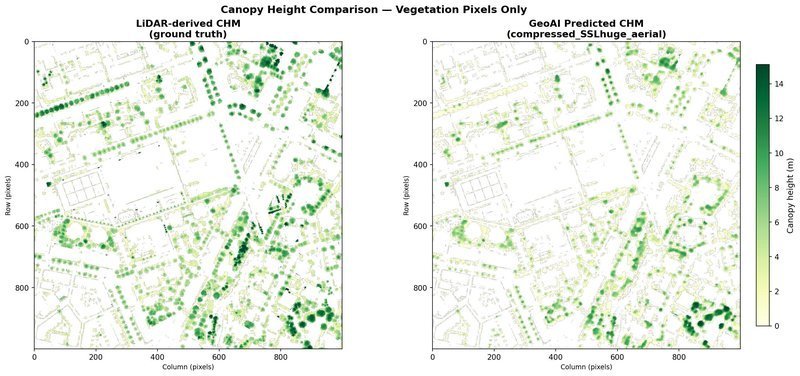
A Pixel-Level Validation
LiDAR is accurate but not freely omnipresent yet. Deep learning models trained on aerial imagery promise a cheaper, scalable alternative — but do they actually hold up? This notebook delivers a pixel-level validation of GeoAI’s SSL-pretrained canopy height model against airborne LiDAR as ground truth across a Helsinki urban neighbourhood.
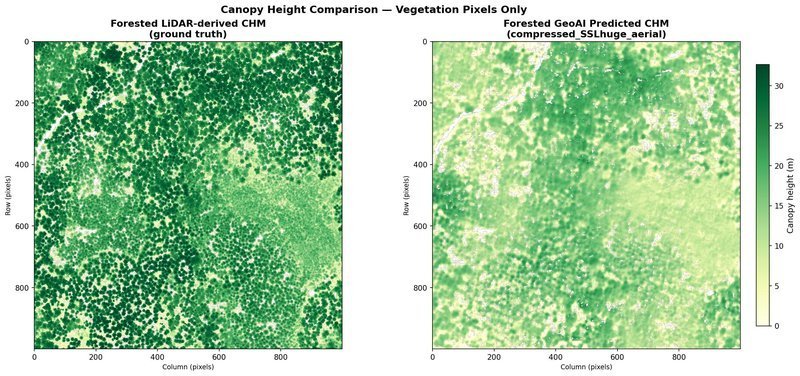
A Pixel-Level Validation
LiDAR is accurate but not freely omnipresent yet. Deep learning models trained on aerial imagery promise a cheaper, scalable alternative — but do they hold up in dense forest where the canopy is closed and individual crowns are harder to resolve? This notebook delivers a pixel-level validation of GeoAI’s SSL-pretrained canopy height model against airborne LiDAR as ground truth across a Helsinki forested site.
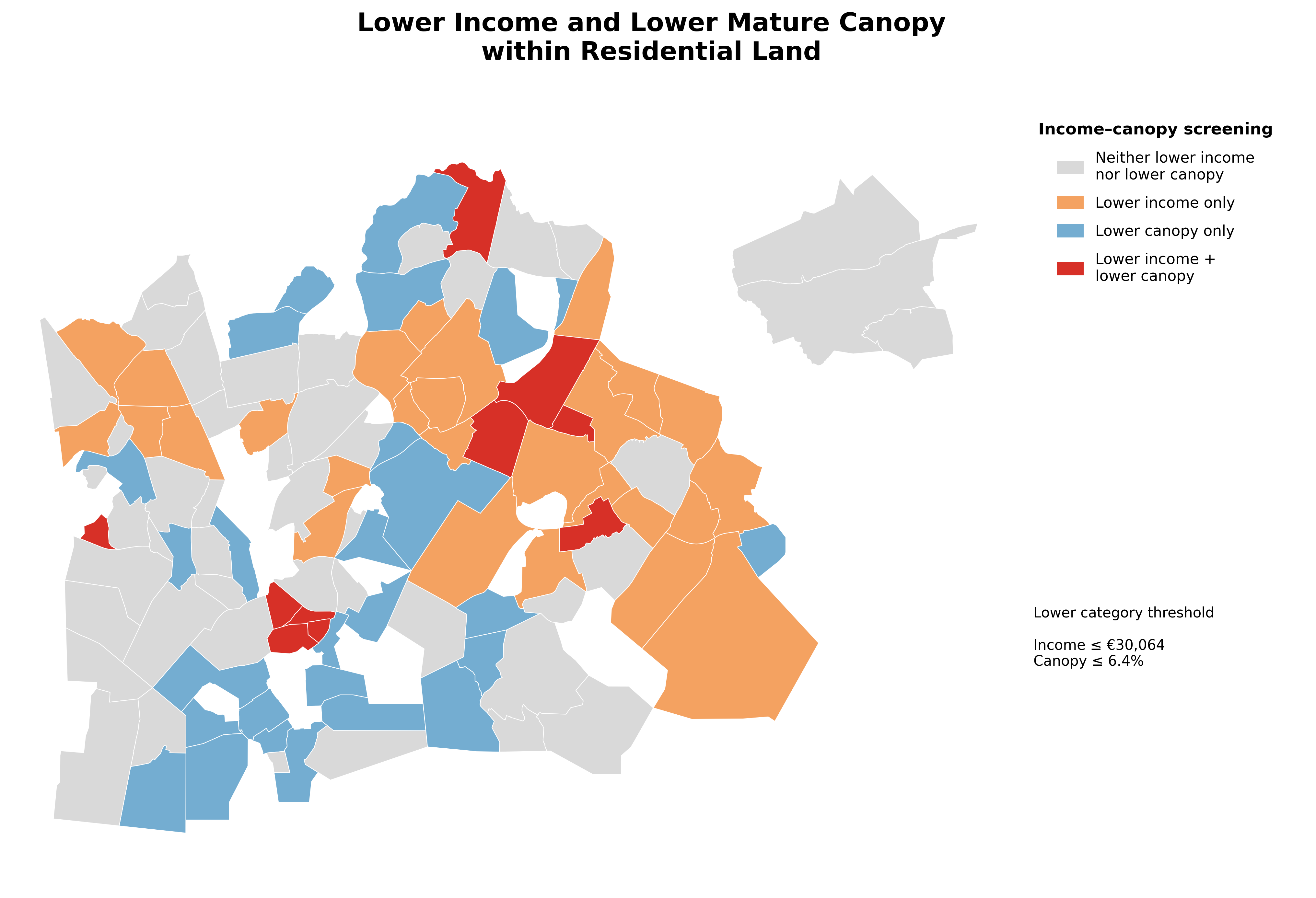
Urban Nature Inequality — Income & Residential Tree Canopy
Are Helsinki’s leafier neighbourhoods also its wealthier ones? This fully reproducible pipeline measures mature tree canopy (≥ 10 m) on residential land across every sub-district and tests it against median income. The city-wide signal is essentially flat (Spearman ρ ≈ 0.01) — income alone does not explain residential tree cover. Yet a tercile screening still pinpoints the sub-districts carrying a double disadvantage — lower income and lower canopy — the natural first targets for urban greening.
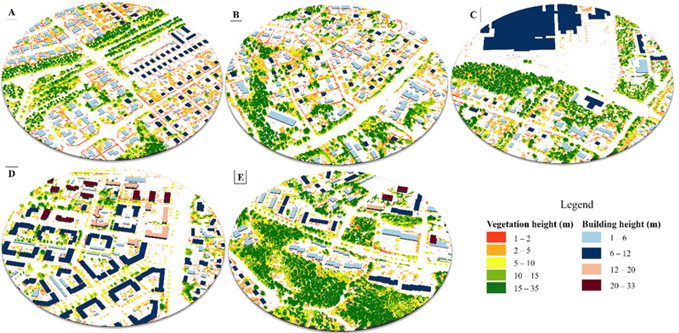
3D built-green typologies — Nordic residential areas
Not all residential areas relate to green infrastructure the same way — and planning that ignores this distinction misses where and what investment is most needed. This project explored five LiDAR-based urban-green typologies.
A direct planning tool for identifying which housing types need which vegetation layer — shrub, sub-canopy, or canopy — and where. View full project →
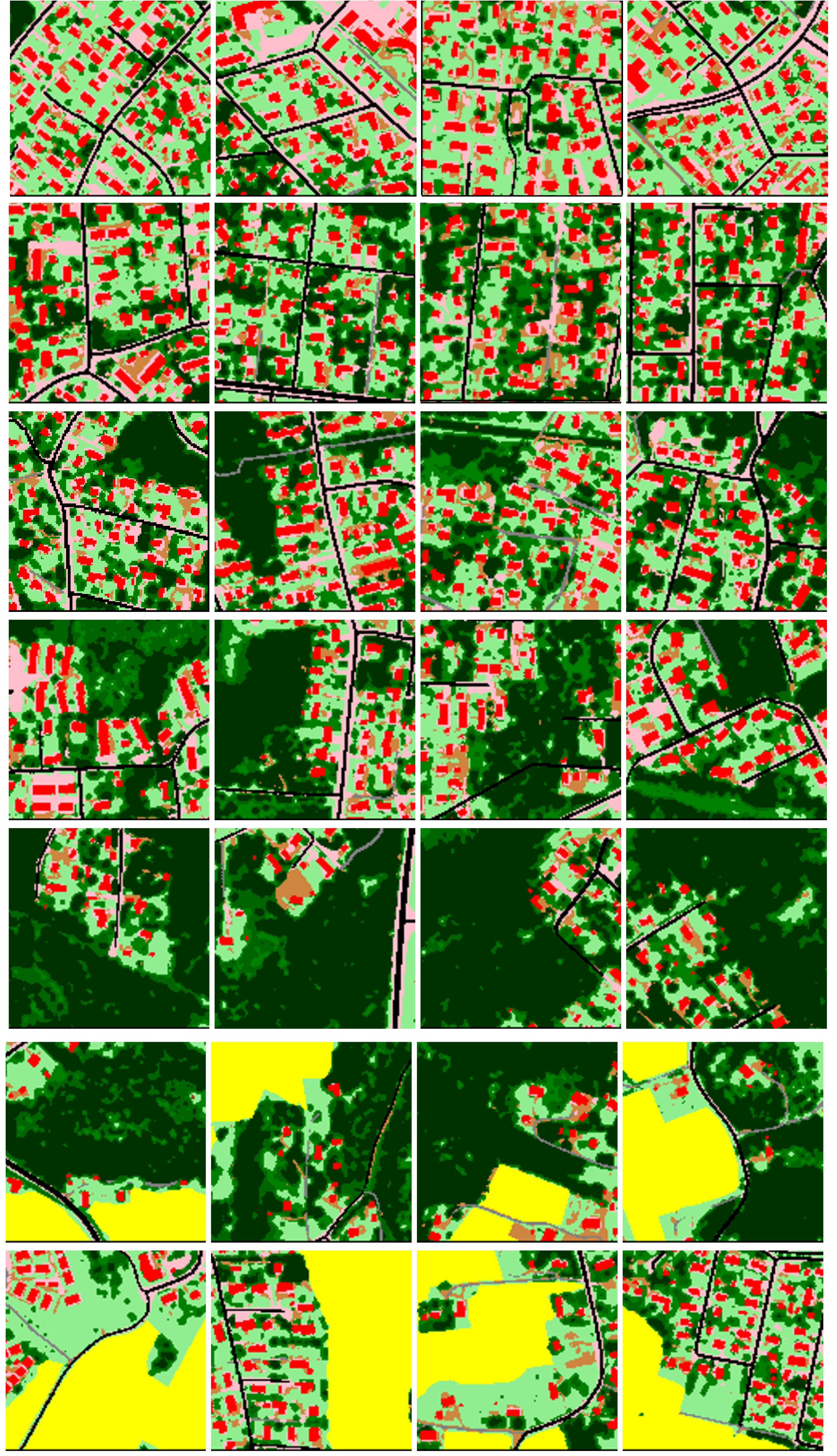
Automating the capture of Urban Residential Typology — Built-Vegetation Hybrid Associations
A scalable approach to capture residential typology hybrid associations across the Helsinki Metropolitan Area — combining deep learning with building and vegetation height information at planning scale. Attempts to answer questions like : Can GeoAI help design better cities by identifying green infrastructure needs at planning scale? Do green infrastructure needs fundamentally differ between detached housing and high-rise flats? Which housing types need investment and what vegetation layers — shrub, sub-canopy, or canopy — are missing?
Code releasing on paper acceptance
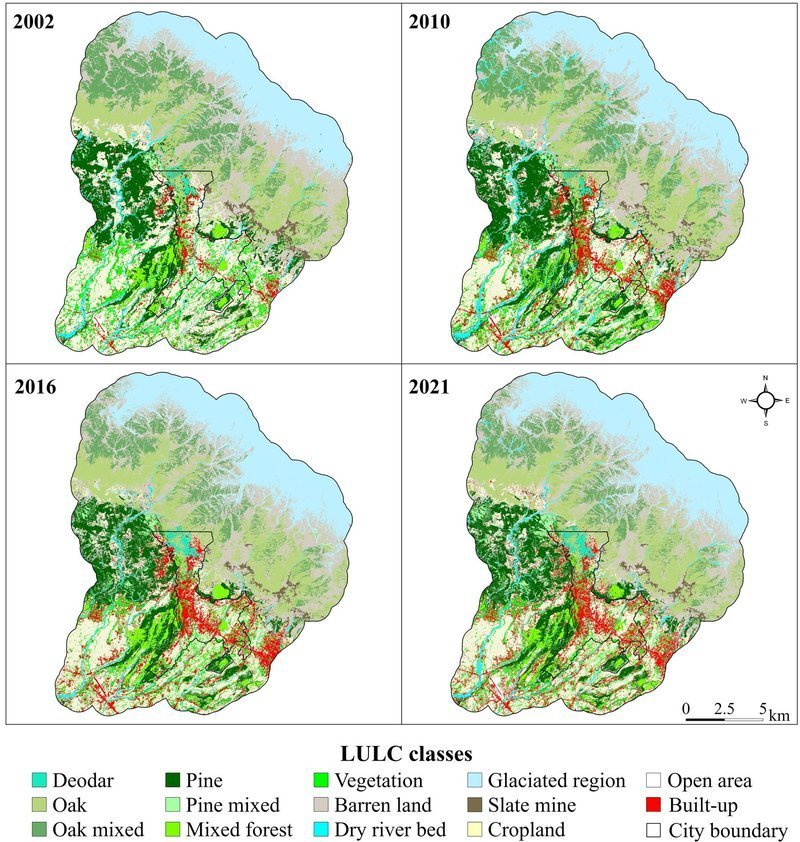
Spatio-temporal LULC assessment
Unplanned urban growth in mountain cities rarely makes headlines. Two decades of urbanisation-induced land cover change mapped at species-level resolution across Dharamshala and Pithoragarh using open-source satellite data. Quantified what, how much, and where natural and semi-natural land units were lost — directly actionable for mountain city planners.
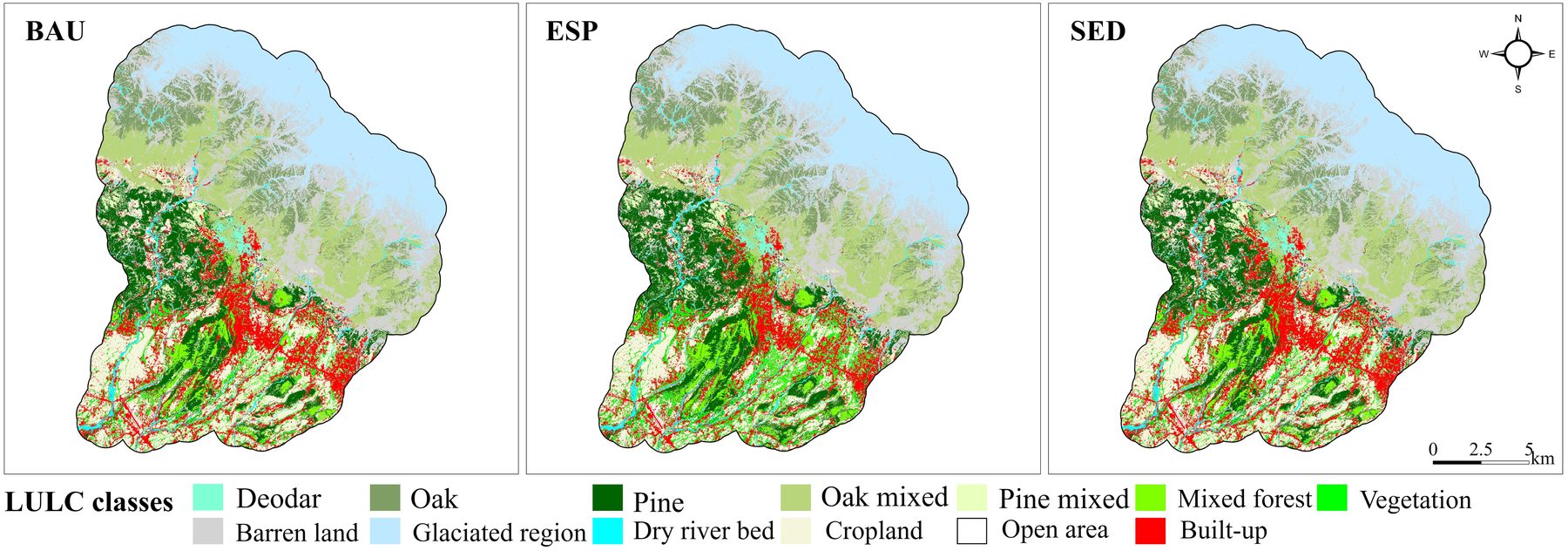
Future Studies: Urban growth scenarios
Unplanned growth in mountain cities rarely follows a single path — but planners need to see all of them. Three plausible futures — Business As Usual, Ecosystem Protection, Development-First. Spatial maps designed for stakeholder deliberation: What does each plausible path look like on the ground by 2040?
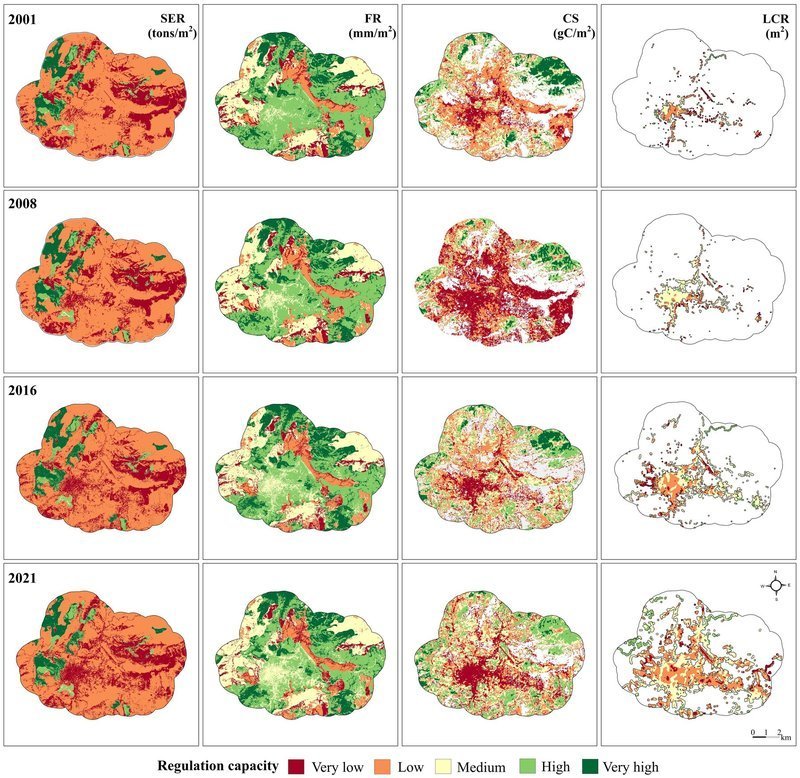
Past, Present & Future of Ecosystem Services — Western Himalaya
Flood regulation, carbon sequestration, soil erosion, and local heat mitigation — spatio-temporally quantified, hotspot-mapped, and projected under three combined planning and climate change scenarios across two Himalayan urban landscapes. Which areas are crucial for each ecosystem service? Where can development expand without compromising ecosystem resilience?
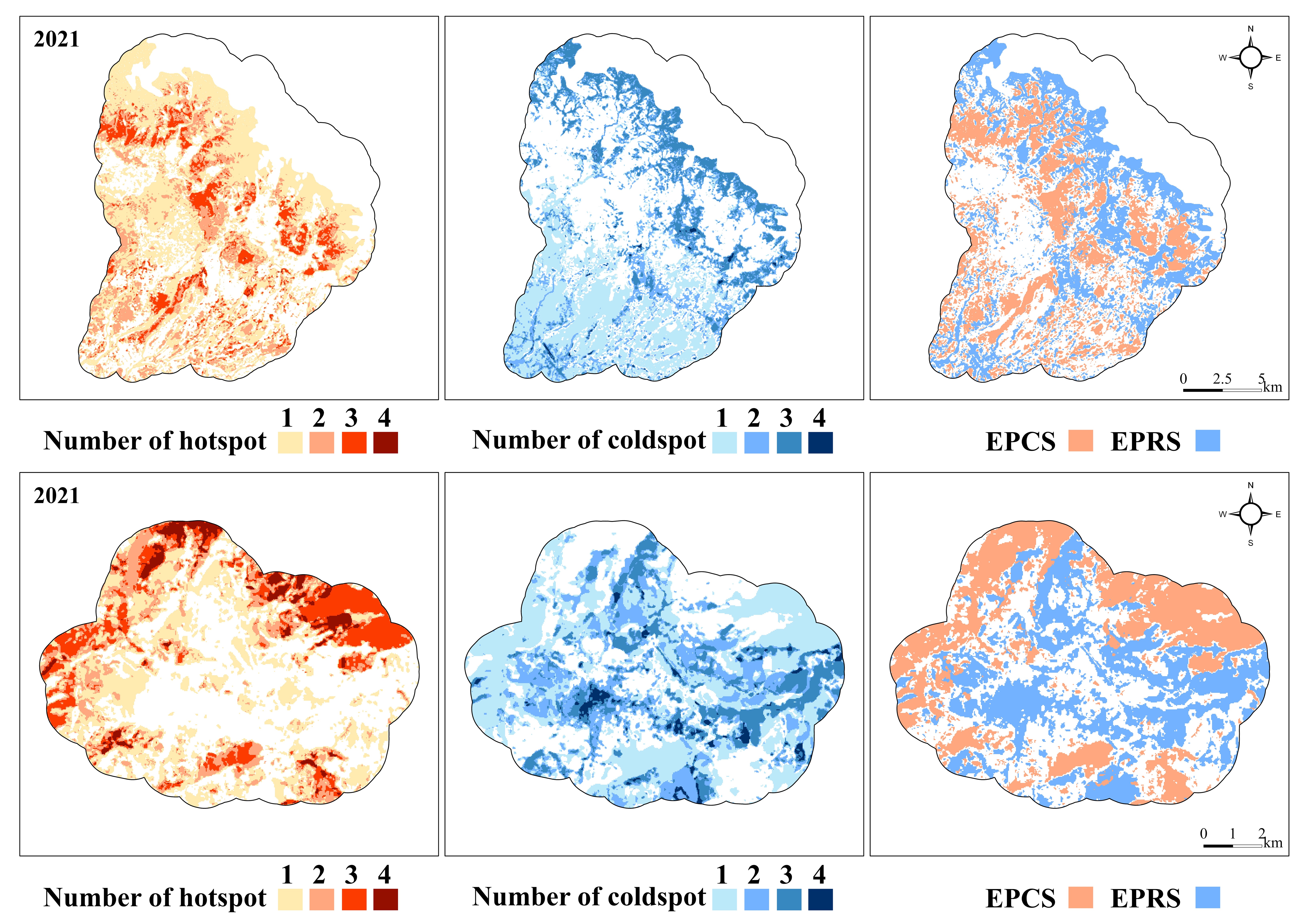
Compound Hazard Zones — Western Himalaya
Mountain cities don’t face one hazard at a time. Where flood buffering, erosion control, and heat regulation collapse together, compound risk zones emerge. This project makes that spatial convergence visible across Dharamshala and Pithoragarh — identifying where nature’s defences have failed simultaneously, and translating that into conservation and restoration priorities directly actionable for planners.
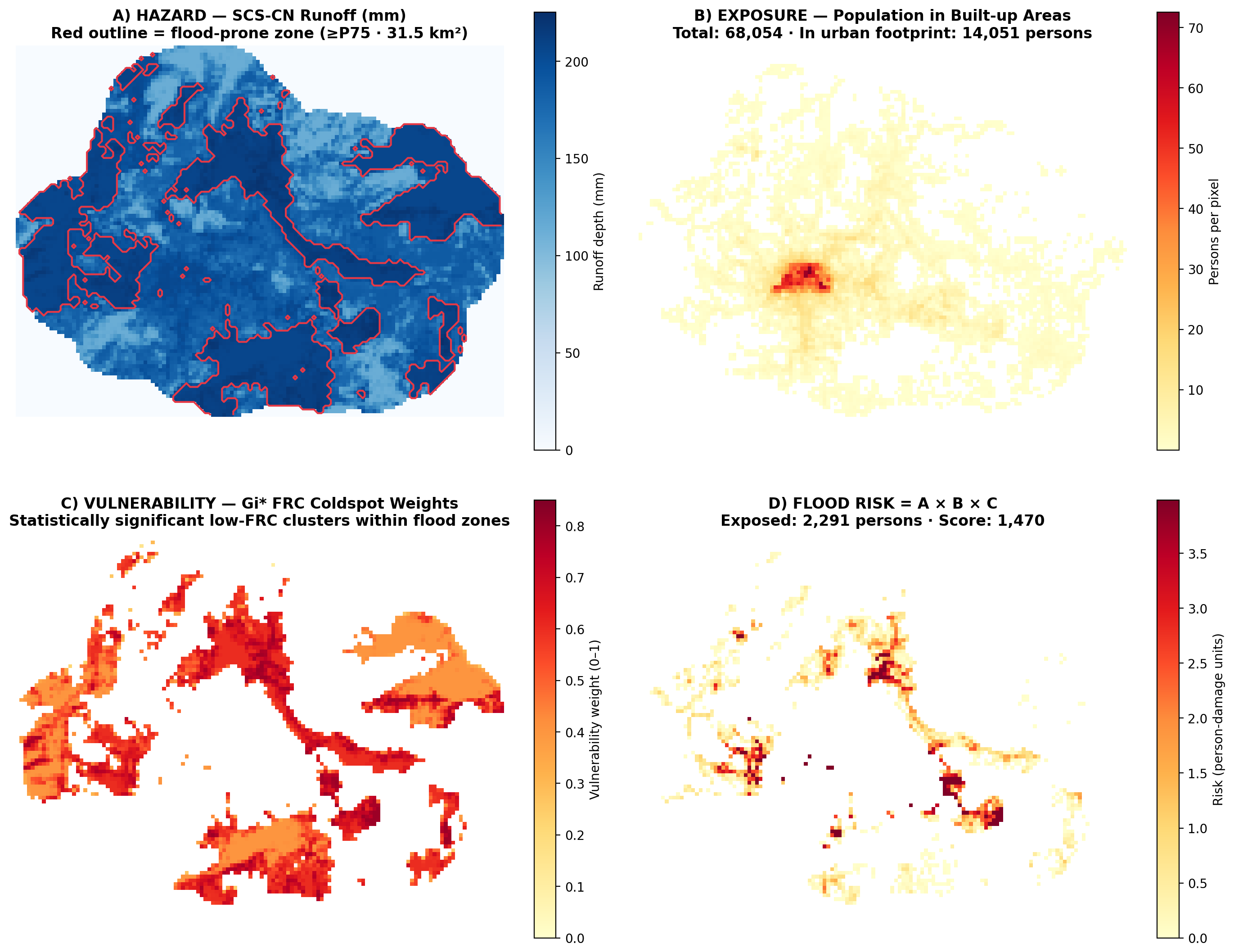
Flood Risk Assessment — Pithoragarh Sub-watershed
This notebook translates biophysically modelled flood regulation ecosystem services into a spatially explicit disaster risk framework — RISK = HAZARD × EXPOSURE × VULNERABILITY. Vulnerability is derived as coldspots of Flood Regulation Capacity; Exposure captures population count in built-up areas via WorldPop : a first-order estimate of how many lives are in harm’s way, not a socioeconomic damage assessment. No external damage curves; no global lookup tables — only locally-validated evidence used to explore number of inhabitants affected.
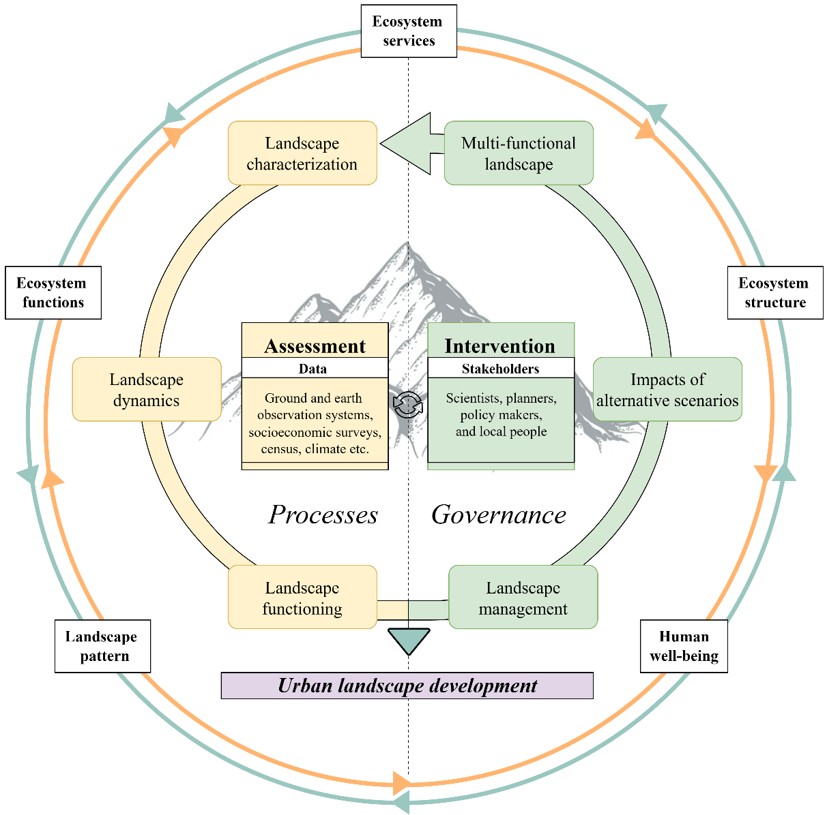
A Planning Framework for Sustainable Mountain Landscapes
Mountain planning fails not for lack of ambition, but because ecological evidence and governance run in separate tracks and never meet. This framework connects them — linking landscape assessment, scenario modelling, and governance into planning decisions. Applied across three projects in the Western Himalaya and transferable to any rapidly urbanising mountain landscape.
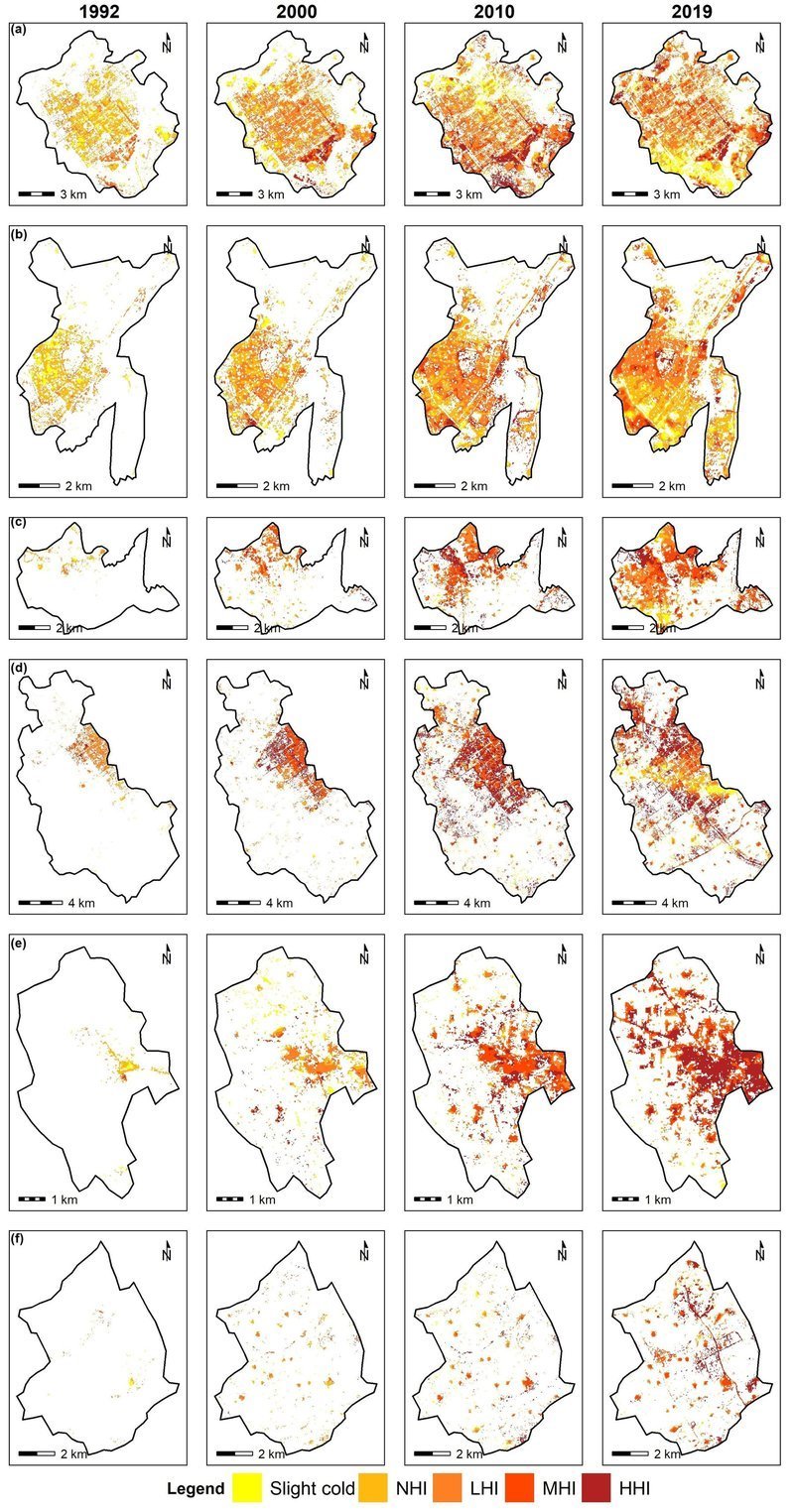
Urban Heat Island — Chandigarh & Satellite Towns (1992–2019)
Counter-intuitive finding: smaller satellite towns had worse heat islands than the larger planned city. Green space distribution matters more than total area — direct implications for satellite town masterplanning across South Asia.
Publications
Peer-reviewed (6)
Dennis, M., Huck, J., Holt, C., McHenry, E., Andersson, E., Sharma, S., and Haase, D. (2026). In search of Schrödinger’s patch: A functional approach to habitat delineation. Landscape Ecology, 41, 36.
Dennis, M., Huck, J., Holt, C., McHenry, E., Andersson, E., Sharma, S., and Haase, D. (2026). Beyond the patch: Leveraging the notion of realized habitat in fragmentation-biodiversity research. Landscape Ecology, 41, 37.
Sharma, S., Joshi, P.K., and Fürst, C. (2022). Exploring multiscale influence of urban growth on landscape patterns of two emerging urban centres in the Western Himalaya. Land, 11, 2281.
Sharma, S., Joshi, P.K., and Fürst, C. (2022). Unravelling net primary productivity dynamics under urbanization and climate change in the Western Himalaya. Ecological Indicators, 144, 109508.
Sharma, S., Sharma, M., Anees, M.M., and Joshi, P.K. (2020). Longitudinal study of changes in ecosystem services in a city of lakes, Bhopal, India. Energy, Ecology and Environment, 6, 408–424.
Sharma, S., Nahid, S., Sannigarhi, S., Sharma, M., Anees, M.M., Sharma, R., Shekhar, R., Joshi, P.K., Basu, A.S., Pilla, F., and Basu, B. (2020). A long-term and comprehensive assessment of urbanization-induced impacts on ecosystem services in the capital city of India. City and Environment Interactions, 7, 1-12, 100047.
Under review (2)
Sharma, S., Maija, T., and Andersson, E. (n.d.). Situating private urban green spaces — using transfer learning to characterise urban landscapes. Urban Forestry and Urban Greening.
Sharma, S., Andersson, E., and Dennis, M. (n.d.). Qualifying and navigating urban heterogeneity for biodiversity. Ecography.
In progress (2)
Sharma, S., Andersson, E., and Dennis, M. (n.d.). How scales matter? Urban ecological qualities for birds. Ecosphere.
Sharma, S., Joshi, P.K., and Fürst, C. (n.d.). Rampant or ecological? Urban growth pathways in Himalaya. Ecological Indicators.
Contact
If you are working on something where cities and their nature, forest, and spatial data intersect & feel I could be a good addition to your team/projects - I would love to have a chat.
📧 ssonalipduoh@gmail.com · LinkedIn · +49 152 160 44085 · +358 45 851 2118
📍 Goslar, Germany | 📍 Helsinki, Finland · Open to on-site roles in Germany, Finland; and remote across Europe and beyond.
This portfolio is actively growing — new projects and notebooks added regularly.